26 in 26: Mausritter
Mausritter
Published 2020 by Games Omnivorous, designers Isaac Williams, Andre Novoa
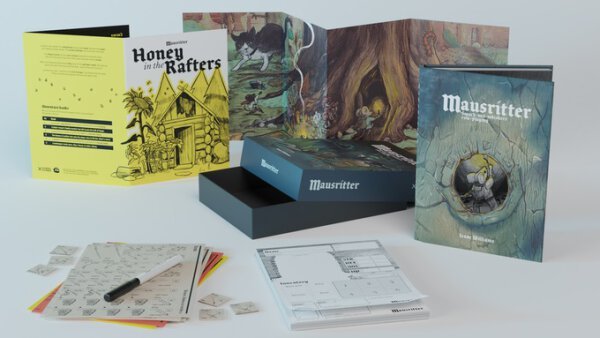
The first game I played in 2026 was Mausritter, an all-ages tabletop game inspired by, and perhaps part of the tradition of, the Old-School Renaissance. The game comes in the form of a beautiful, thin volume of rules packaged in a box set that also includes five or six cardboard sheets of punch-out tokens, a pad of character sheets, a dry-erase marker, a single A5 rules cheat-sheet, a GM’s screen, and an adventure titled Honey In the Rafters.
Spectacular. Just spectacular - you’re given a whole bundle, everything you’ll ever need to play the game for about the same price as a single core rulebook of most modern games ($65.00 from Exalted Funeral, £50.00 from Games Omnivorous, if the dollar figure matters). Not only do you get the whole package, you get it in exceptional quality. Every item in the box feels nice.
For our game we played the included adventure, Honey in the Rafters. The adventure is barely a slice of content, a tri-fold A5 with an illustration on the front, a blurb and adventure hook table on the back, and four pages left for all the locations, characters, treasures, curses, and story remaining. As you might guess, there’s not much there. You’re given a handful of names, threats, and goals, and left to your own devices. This is where the OSR nature of the game comes through the clearest: rules can be light but story-focused, but the real mark of an old-school game is when it hands you an adventure with nothing but a few names scratched on an index card and says “here, this is all you need.”
Our group used randomly-generated mice and immediately set out to investigate the edges of their world where a ramshackle abandoned hut, festooned with droning black bees seems to draw in mice from the local farms and towns with the powerful call of honey candy. They considered approaching the coal-black stalk of the giant sunflower in the overgrown front garden, and the musky and cavernous rotten log out to the West, but elected instead to head straight to the hut. In they went to approach the cult of the Sweet Tooth, offer to retrieve honey from the hive on their behalf in exchange for a supply of their candy, and on they go. One dead mouse and a smash-and-grab later and they’ve got what they came for and retreat, unsatisfied with the mysteries they left behind but grateful to walk away alive.
A Quick Review
Concept 6/10
Look, I love the concept. You’re little mice in a big world. You use scraps of humanity’s leavings and a bit of grit to make your way through a countryside that’s transformed in ways strange to you, fighting monsters that far, far outclass you, like cats. So why rate it only six out of ten? Because it’s been done! Redwall, the Borrowers, Mouse Guard, The Secret of NIMH, Watership Down, pick a thing. The idea of a teeny-tiny adventurer in a world of giants is antique, and modern interpretations are thick on the ground. Add in the twist that you’re mice and you’re still among great company.
So what does Mausritter do that the other titles don’t? Not much that I can see. The game will need to stand on its merits rather than novelty or the strength of a conceptual hook. What it does have going for it is that you’re fragile. Every mouse is in danger, which helps to reinforce the idea that you’re going up against forces far, far beyond yourself. Every time combat starts your character could eat it - just one nasty hit can take out most starting characters, and you’re not adding a lot of survivability as the game goes on.
Rules 7/10
The rules presented in the book are lightweight. Of a few dozen pages, half are taken up with illustrations. The rest is what composes the game in its entirety: a few rules to randomly roll up your mouse, a few rules to engage in combat, and three stats that give you all the tools the game intends to give you when it comes to accomplishing tasks. With a bit of finagling you could easily arrange a session - maybe a whole adventure - of Mausritter that did not require the character sheet at all. In some ways this is grand. One of the game’s stated aims is to bring new players to the table, and the fewer and simpler the rules can be, the better. In some ways this handicaps the game unnecessarily. There’s no nuance! There are few levers to pull when it comes to difficulty, circumstance, whatever else. With four or five numbers you have a character, and the limitations may chafe after a while.
Tools 4/5
In such a wee book how do we have time for tables, charts, and the other fiddly bits that make up good tools for the Game Master or other players? Well the truth is, we don’t - they’re not in the book! The best tool you can pull out of Mausritter - maybe the only one - is the inventory system. On the character sheet there are ten little boxes: two for your hands, two for your body, and six for your backpack. Everything you have is going to go on one of those little boxes in the form of a cardboard token. Your mouse is going to start with a torch, rations, a hand tool or two, a weapon, maybe armor. So we have simplicity: even a young child can understand that you put these tokens on these spaces, and you have to get rid of things when you have too many. We have game-able substance: like old video games you may have to do a bit of inventory shuffling. Woe if you have to arrange it during a tense fight - every action to retrieve and drop something from your backpack is going to smart. We’ve also got a way to track consequences for your mouse. In Mausritter your mouse may be subject to curses, exhaustion, injuries, and other effects that trouble them. Like items and spells and treasures, those take up space in your inventory! You have a full backpack and you roll your ankle? You need to start looking at what you want to drop from your goods so you can keep going with your companions. This single tool earns Mausritter 4 points where it could have walked away with none.
Writing 2/5
Brevity is the soul of wit, but that doesn’t prove out in a manual or guide like a game rulebook. The game’s writing never falls down entirely, but it never excels. Sentence fragments, stunted thoughts, and direct language permeate. The advice to the players - to be bold, die often, roll up a new mouse - is the start and end of the eloquence in the game. The rest is brutalist, effective language that earns no points.
Clarity 3/5
You’d imagine that in a book so short, with rules so simple, clarity would be a natural byproduct. Not so, unfortunately. There’s nothing to get lost here, and you’ll never be left searching for the rest of the rules, but what you might struggle with is identifying what a rule means in context or how it might be used. There are no examples, no clarifying text, and no guideposts for the reader. This is a sin for one reason only: it’s a game for new players! Here we see the collision of writing for the OSR - a group of players that are familiar with the genre, with rules traditions, maybe with editions from 1976 to present - and writing for a family with kids. If you’re looking to dip your toes into RPGs for the first time Mausritter is not going to hold your hand, and that may be why we see so many new players gravitate to D&D and the other titans of the scene. They’re clear! If you read the book, you finish knowing what you’re meant to be doing. Players in the OSR may opine that these trad games baby the reader too much, that the old-school games allow freedom to do what players think of at the table, but let the new players have their training wheels. Especially if it’s a game that, ostensibly, should be playable by kids!
Layout 5/5
Simple, direct, does what it needs to then gets out of the way. The black-and-white illustrations in the book are easily read, the tables and rules are all in BIG TEXT that catches the eye where it needs to. That is, the sparseness that injures the book’s Clarity redeems itself here. Nothing seems worth dinging the score, and to me that means a 5.
Outside the book we see the same thing on the character sheets - an A5, single-sided sheet has everything you need to play, laid out such that you’ll never be searching for a number. The GM screen has frequently used material on the interior, random stuff in a mouse’s pockets, a run-down of the rules, everything you could want close to hand when you’re running the game.
Art 5/5
Little mice! The Concept isn’t original, the writing not evocative, but that’s because the author passed that off to the illustrator. The art in Mausritter is wonderful. It shows you what you’re doing, where you’re going, the world in which these mice live and adventure. While running the adventure I found myself often gesturing to the fully-illustrated GM screen, the book, the adventure tri-fold to show folks what they were looking at and how the world was shaped around them. And let’s talk about the accessories for a moment! The screen, book (inside and out), the adventures, the tokens, all these have wonderful illustrations scattered about them, every spare bit of space has got something to show you.
Production 5/5
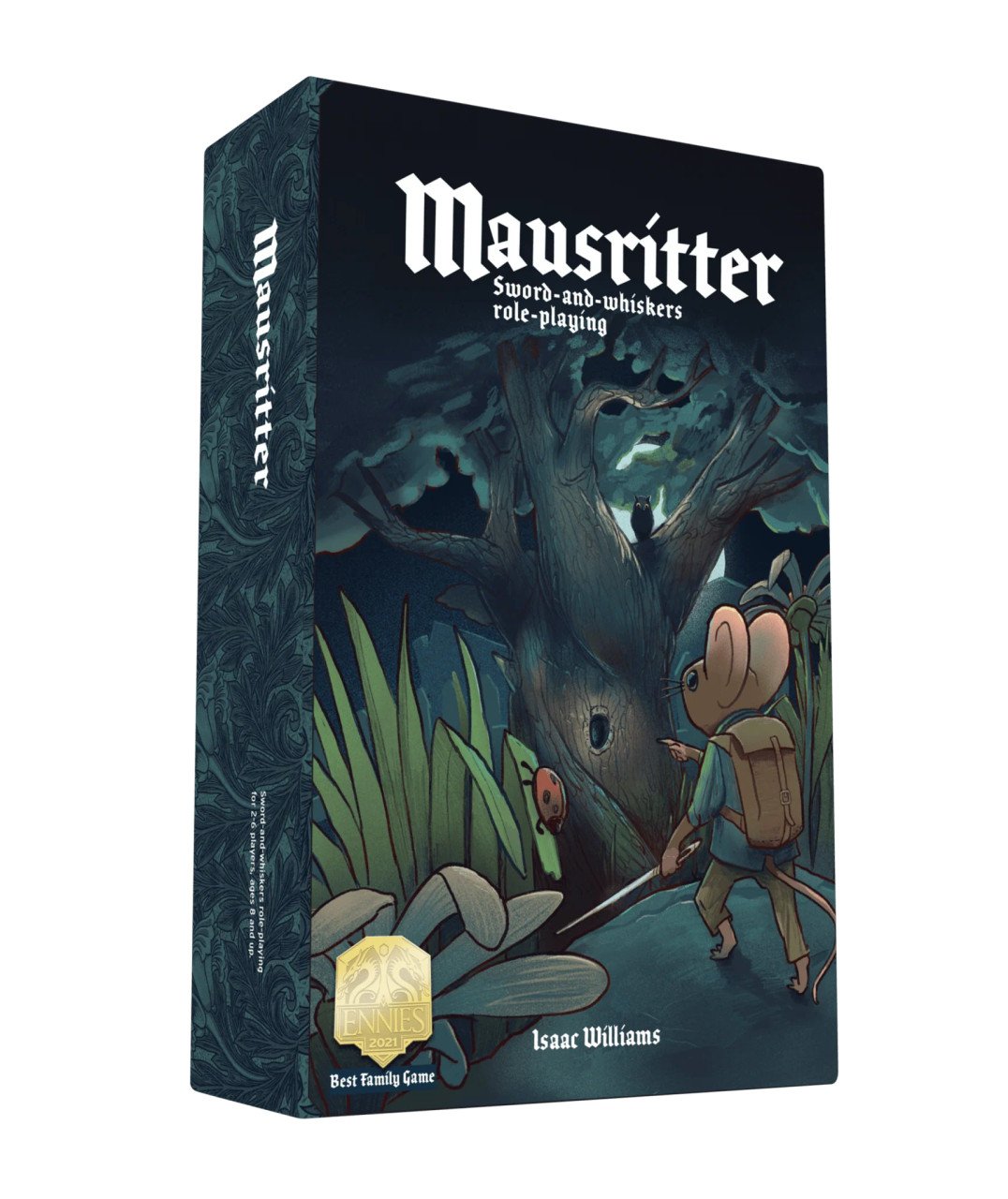
What a wonderful physical artefact. The box set is a lovely item from top to bottom. The book and its accessories are all A5 size, one of my favorite formats. The book’s cover features a cut-out revealing a mouse, torch lifted against some danger, an added flair that was totally unnecessary for the book but extremely pleasant. The feel of the cover is excellent. The paper has a rough hand to it that feels homey, a smart choice to avoid the slick or glossy feel of most RPG books. The tokens are on thick, resilient cardboard with a surface treatment that allows you to mark them with dry erase and then, vitally, erase. The GM screen is A5 size, four panels, enough to hide a sheet or two of paper and a few dice behind it but not high enough to obscure your sight over the top (a pet peeve: GM screens that are 12+ inches tall often make it impossible to see a map on the center of the table). The adventures, both Honey in the Rafters and the many adventures that come in The Estate campaign box set, are A5 tri-fold pieces that use every spare inch and are printed on nice cardstock. Really, I can’t say too many nice things about the production quality and thoughtfulness of the box set, it’s a wonderful piece.
My one gripe: an A5 book slots in alongside my other A5s, where an A5 box set needs just a centimeter or two more in height and depth. C’est la vie.
Total Score 37/50